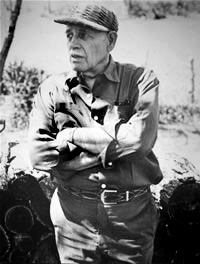
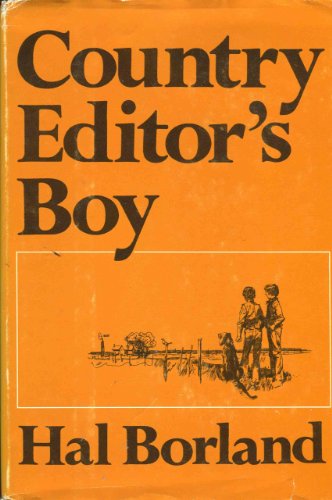
In his 1970 memoir Country Editor’s Boy, Hal Borland recalled the first time he saw Denver and the Rocky Mountains in June of 1915. The Borland’s had left their remote homestead on the plains of Eastern Colorado the previous summer and moved north to Brush, where Borland’s father, Will, worked a year at The Brush Tribune. In early spring, Will left the Tribune and purchased The Flagler News, a weekly newspaper in the plains town of Flagler, just over ninety miles southeast of Brush. Will traveled to Flagler alone, secured the paper and housing, and fifteen-year-old Borland and his mother Sarah followed six weeks later. Direct rail service between Brush and Flagler did not yet exist in 1915; one traveled ninety miles southwest to Denver, then 125 miles southeast back to Flagler. It was on this move to Flagler, during their wait in Denver, that Borland first saw the mountains. In Country Editor’s Boy he wrote:
“Although we had lived in Colorado five years, neither mother nor I had ever seen Denver. . .We started back to the station. We were almost there when mother stopped, caught my arm, and exclaimed, ‘Look!’ Off to the west, in a gap between two tall buildings, was the incredible loom of the mountains twenty miles away. They were huge, bare and rocky. Beyond them rose other mountains, dark and green with trees, countless mountains. We stared at them, fascinated, and we turned down a side street and walked two or three blocks to a place where we could see them better. The sun shone on them, almost glinting, and big, high clouds cast dark shadows that climbed their slopes as we watched. They looked only a few miles away in the clear, thin Colorado air. Seeing them, I knew that someday I would have to go to them, climb them, see what lay beyond. But not now. Now they were a barrier, a rugged obstacle to eyes familiar with the flat immensity of the plains. . .I wanted no part of such barriers, no hemming in. I was glad we weren’t moving to a town in the mountains. Flagler was a plains town where, father had written, you could see forty miles in any direction.”
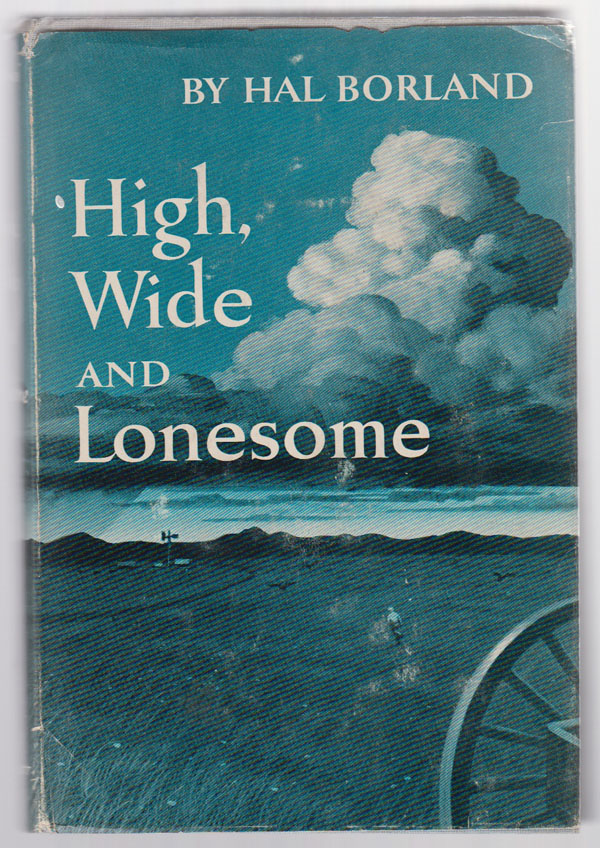
This was not the first time Borland had written about the Rockies. In his 1956 book High, Wide and Lonesome, Borland recounted the homestead years 1910 to 1914. Will and Sarah Clinaberg were married in Sterling, Nebraska on April 26, 1899, where Harold Glen (Borland did not adopt the name “Hal” until the 1920’s) was born on May 14, 1900. In February of 1910, Will–an exceptionally talented newspaper printer and editor–left his position at The Sterling Sun and filed his homestead claim on the dry, treeless grassland plains of Eastern Colorado. The Borland’s built a “soddy” on their claim, two miles from the nearest neighbor and nearly thirty miles from the closest doctor in Brush.
After a difficult year that exhausted their supply of food and cash, Will took a temporary position editing a newspaper in the mountains at Pagosa Springs during the summer and fall of 1911. He would travel by train from Brush to Denver and then on to Pagosa, telling Sarah, “I’ll go Monday and you two can come later.” But Sarah was insistent that she and Harold stay and tend the homestead and Will travel to Pagosa alone. In High, Wide and Lonesome Borland wrote:
“I thought: We can’t move to some closed-in town where you can’t see anything or do anything! . . .I felt a big relief. We weren’t going. Father was going, but he would be back this fall. He was saying, ‘All we need is a little cash. Just enough to get us over the hump this summer. Get some food in the house for next winter, and some coal. And maybe even buy another cow or two. That’s all we need. And this is the chance to get it.’ That night mother washed his shirts and sewed his buttons, and on Monday morning we took him to Brush and he got on the train to Denver and the mountains.”
Over the next thirty pages of High, Wide and Lonesome, Borland recalls his and Sarah’s experiences on the homestead while Will was away at Pagosa. Throughout the book, Borland mentions climbing the haystack and sand hills, searching the horizon for the mountains, out of view far to the west. But convincing evidence from Borland himself tells a different story–that he did in fact visit Pagosa in 1911, thereby rendering both published accounts inaccurate.
In November of 1953 Borland received a letter from a journalism student at the University of Colorado. The student had chosen Borland as the topic for his senior “independent study” project and wondered if Borland would supply some biographical information. Borland responded with a seven page, single-spaced letter giving a detailed account of his life and career thus far. In his letter Borland wrote:
“During the summer of 1911 my father spent several months at Pagosa Springs, editing the Sun there for a political campaign; during that time I roamed the hills and became acquainted, as a boy will, with old miners, loggers, and Ute Indians, learned a smattering of Ute, hunted a bit and fished a bit with them, learned something of the way they lived. All factors in things I later wrote.”
Two years before the student letter, Borland’s article Lost Retreat was published in The New York Times. Lost Retreat is Borland’s account of his dream to build a cabin high in the mountains above Pagosa Springs, a retreat where he could fish and write, where “One could live here in simplicity, work as one wished, be isolated when one wanted isolation, or go out from here into the busy, fretful world. . .What better life could one ask than to live here in these mountains and fish and write books.” Borland had chosen the site for his cabin during a trip to Pagosa Springs after his marriage and graduation from Columbia School of Journalism in June of 1923, camping in the mountains and completing his first book, Rocky Mountain Tipi Tales. In Lost Retreat Borland mentions the 1911 trip as inspiration for returning there in 1923:
“I had known Pagosa briefly as a boy, when I came here with my father to fish for trout in the swift white waters of the upper San Juan River. I came back here in the 1920’s to write a book about the legends and folklore of the Indians. . .I came here and wrote my book, and when it was completed I loaded a pack horse and went back into the mountains to fish. The fishing was good, and the mountains were wonderful with summer. I was returning from that trip when I found my retreat.”
Borland left soon after to take a job “back east,” and did not return to Pagosa until 1951, hoping to find his lost retreat:
“I drove out of Pagosa on the asphalt road. . .looking for my hilltop. I found it with little trouble. A side road, unpaved but of well-graded gravel, leads off into the hills. I followed it, and parked my car, and walked a quarter of a mile, and there I was. . .My hilltop was no longer remote. . .I walked about that high meadow looking in vain for a mariposa lily. It was several minutes before I remembered that the mariposas, which are like a vivid, three-petaled tulip, must have finished blooming a month or more ago. Then I realized that I had been trying to recapture something that is gone forever. Like the mariposas, my dream of a retreat up here bloomed in its proper season and was now gone.”
Perhaps most telling is a December 1962 letter Borland wrote to his editor, in which he recalled a trip he and wife Barbara had made to Mesa Verde National Park in the early 1950’s:
“Mesa Verde is not far beyond Pagosa Springs, so we stopped in Pagosa and I saw several old friends there, talked of the old days. In my youth I spent some time there and knew some of the old Utes, even went with one small group of them on a fishing and berrying trip back in the hills. I recalled this to Barbara and told her about the old tales the Utes told me and the old chants they sang around the fire in the evenings. We saw Pagosa and drove on through Piedra Town and Bayfield, with the Southern Ute reservation just off to the south, and went on to Cortez, Colo., and into the park and up the Mesa.”
And in a November 1964 letter to Peter Farb, Borland stated definitively, “I spent the better part of a year in Pagosa Springs in my boyhood and have been back several times.” I also have an author bio Borland gave to his publisher, as well as additional correspondence, where he references 1911. Though these examples are somewhat vague on the exact length of his stay, there is no question that Harold (and certainly Sarah as well) visited his father in Pagosa during the summer and fall of 1911, and it is unlikely he traveled any route other than by way of Denver. Why, then, did Borland give alternate accounts in High, Wide and Lonesome and Country Editor’s Boy? Are the events he details in the thirty pages of High, Wide and Lonesome fact or fiction, or a combination of the two?
Copyright 2022 Kevin Godburn All Rights Reserved
Discover more from halborlandamericancountryman.com
Subscribe to get the latest posts sent to your email.

